
News & Insights
Insights

Insights

Insights
April 22, 2026
Latin America Energy: The New Supply Frontier
Insights
April 14, 2026
A Defensive Strategy in the Healthcare Sector
Insights
November 17, 2025
Water Infrastructure: a Growing Market backed by Governments
1
2
3
Insights
July 4, 2025



Riding the Next Wave of E-commerce
Market Overview
Global e-commerce reached $6.3 trillion in 2024, accounting for 22% of total retail sales. This growth, driven by digitalisation, improved logistics, and the rise of emerging markets, is expected to push the sector to $8 trillion by 2028.
Key growth drivers include widespread internet access, mobile usage, digital payments, and increasing demand for personalisation. Southeast Asia, India, Africa, and Latin America are showing double-digit growth rates.
Competitive Landscape
Global giants like Amazon, Alibaba, MercadoLibre, JD.com, and Sea Group are facing growing competition, with dynamic local players emerging fast. The ecosystem is becoming more fragmented, fuelled by the rise of direct-to-consumer models, the influence of social commerce (e.g. TikTok Shop), and traditional retailers going omnichannel (e.g. Walmart, Carrefour, Target).
E-commerce is shifting towards an integrated model that combines retail, advertising, logistics, fintech, and artificial intelligence. Platforms are increasingly monetising their data through targeted advertising (Amazon Ads alone generates $50 billion), subscriptions, and financial services.
Technological Innovation
The sector is harnessing generative AI for product recommendations, warehouse automation, predictive delivery, and experimental technologies like drones. These innovations are cutting operational costs while enhancing the customer experience.
Investment Strategy
Only companies with integrated, tech-driven, and geographically diversified models are likely to stand out. Firms that combine platforms, logistics, advertising, and fintech capabilities such as Amazon, MercadoLibre, and Sea Group, benefit from defensible economies of scale.
Exposure to emerging markets offers strategic upside, thanks to low e-commerce penetration and the rapid rise of a connected middle class. Regional leaders like MercadoLibre, Coupang, and Shopee show strong growth potential with scalable business models.
Thematic ETFs (e.g. Amplify Online Retail, Global X E-commerce) offer diversified exposure while mitigating company-specific risk.
In conclusion, e-commerce in 2025 still holds strong potential, but success requires a nuanced understanding of regional and competitive dynamics. Investment calls for a selective approach focused on robust business models and presence in high-growth markets.
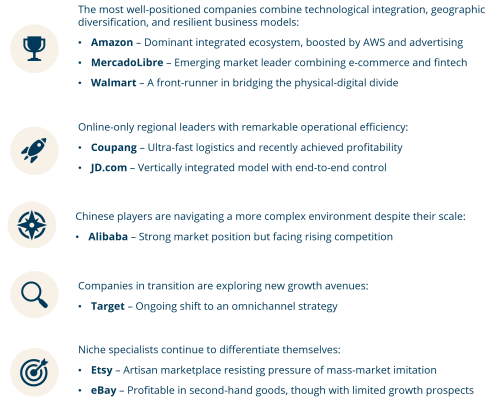
Positioning of Key Players
Insights
July 4, 2025
Riding the Next Wave of E-commerce
Market Overview
Global e-commerce reached $6.3 trillion in 2024, accounting for 22% of total retail sales. This growth, driven by digitalisation, improved logistics, and the rise of emerging markets, is expected to push the sector to $8 trillion by 2028.
Key growth drivers include widespread internet access, mobile usage, digital payments, and increasing demand for personalisation. Southeast Asia, India, Africa, and Latin America are showing double-digit growth rates.
Competitive Landscape
Global giants like Amazon, Alibaba, MercadoLibre, JD.com, and Sea Group are facing growing competition, with dynamic local players emerging fast. The ecosystem is becoming more fragmented, fuelled by the rise of direct-to-consumer models, the influence of social commerce (e.g. TikTok Shop), and traditional retailers going omnichannel (e.g. Walmart, Carrefour, Target).
E-commerce is shifting towards an integrated model that combines retail, advertising, logistics, fintech, and artificial intelligence. Platforms are increasingly monetising their data through targeted advertising (Amazon Ads alone generates $50 billion), subscriptions, and financial services.
Technological Innovation
The sector is harnessing generative AI for product recommendations, warehouse automation, predictive delivery, and experimental technologies like drones. These innovations are cutting operational costs while enhancing the customer experience.
Investment Strategy
Only companies with integrated, tech-driven, and geographically diversified models are likely to stand out. Firms that combine platforms, logistics, advertising, and fintech capabilities such as Amazon, MercadoLibre, and Sea Group, benefit from defensible economies of scale.
Exposure to emerging markets offers strategic upside, thanks to low e-commerce penetration and the rapid rise of a connected middle class. Regional leaders like MercadoLibre, Coupang, and Shopee show strong growth potential with scalable business models.
Thematic ETFs (e.g. Amplify Online Retail, Global X E-commerce) offer diversified exposure while mitigating company-specific risk.
In conclusion, e-commerce in 2025 still holds strong potential, but success requires a nuanced understanding of regional and competitive dynamics. Investment calls for a selective approach focused on robust business models and presence in high-growth markets.
Positioning of Key Players