
News & Insights
Insights

Insights

Insights
July 23, 2026
The American Industrial Revival
Insights
July 15, 2026
Turning election volatility into an entry opportunity
Insights
July 9, 2026
The New Era of Power Infrastructure
1
2
3
Insights
July 9, 2026


The New Era of Power Infrastructure
Electrification is based on a simple premise: a growing share of energy, industrial and mobility uses will be
powered by electricity. This transition requires a fundamental modernisation of the power grid, which was
historically designed for more limited needs, a more carbon-intensive energy mix and a predominantly one-
way system in which electricity flowed from the producer to the consumer.
The development of smart grids is specifically intended to modernise this infrastructure by enabling electricity
generation, distribution and consumption to be managed more effectively in real time. The grid therefore
becomes more flexible, more responsive and better suited to a world in which renewable energy, electric
vehicles, smart buildings, data centres and connected devices are playing an increasingly important role.
Several figures illustrate this trend. According to IRENA, global investment needs in grid infrastructure could
reach approximately USD 720 billion per year by 2030. McKinsey estimates that global electricity demand
could increase by 40% between 2020 and 2030, before doubling by 2050. At the same time, renewables could
account for 45% to 50% of global electricity generation by 2030, rising to 60% to 70% by 2040.
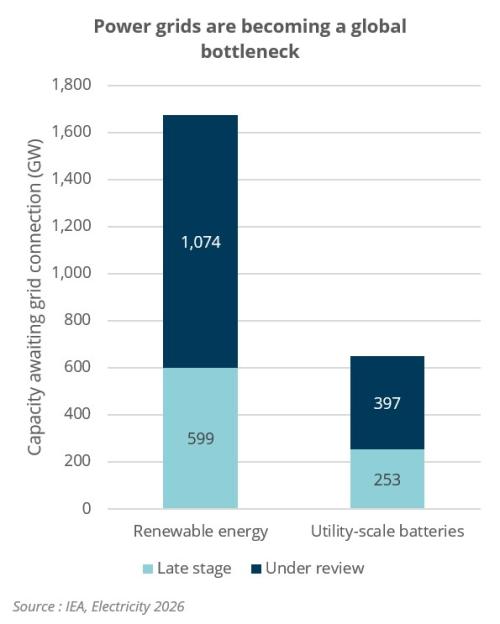
Against this backdrop, the power grid is no longer simply an infrastructure for transporting energy. It is becoming a system capable of distributing, managing and optimising electricity more effectively in line with demand. The shift from a traditional architecture based on centralised generation to a more decentralised and connected model is supporting demand for electrification equipment, intelligent distribution solutions, automation systems, software and related services.
This value chain includes smart grids, electrical infrastructure, electric vehicle charging networks, smart buildings and energy management software. It benefits from several tangible growth drivers, including the expansion of renewable energy, electric vehicle charging, the growth of smart buildings, industrial automation and, above all, investment in data centres and digital infrastructure. These trends are creating growing demand for electrical equipment, energy management solutions and grid modernisation.
Key point to monitor: although the electrification theme is supported by strong structural drivers, companies in the sector remain exposed to more cyclical factors. A slowdown in certain industrial or construction markets, rising costs, currency effects, greater competition or a more uncertain macroeconomic and geopolitical environment could weigh on growth, margins and valuations in the short term.
BENEFICIARIES
- ABB (ABBN SW)
- Schneider Electric (SU FP)
More information available in the Full Trade Idea
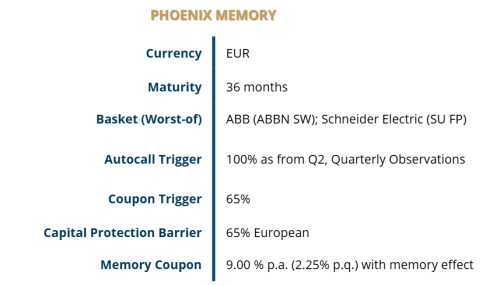
Product Snapshot | Phoenix Memory
For informational purposes only. Not investment advice.
Insights
July 9, 2026
The New Era of Power Infrastructure
Electrification is based on a simple premise: a growing share of energy, industrial and mobility uses will be
powered by electricity. This transition requires a fundamental modernisation of the power grid, which was
historically designed for more limited needs, a more carbon-intensive energy mix and a predominantly one-
way system in which electricity flowed from the producer to the consumer.
The development of smart grids is specifically intended to modernise this infrastructure by enabling electricity
generation, distribution and consumption to be managed more effectively in real time. The grid therefore
becomes more flexible, more responsive and better suited to a world in which renewable energy, electric
vehicles, smart buildings, data centres and connected devices are playing an increasingly important role.
Several figures illustrate this trend. According to IRENA, global investment needs in grid infrastructure could
reach approximately USD 720 billion per year by 2030. McKinsey estimates that global electricity demand
could increase by 40% between 2020 and 2030, before doubling by 2050. At the same time, renewables could
account for 45% to 50% of global electricity generation by 2030, rising to 60% to 70% by 2040.
Against this backdrop, the power grid is no longer simply an infrastructure for transporting energy. It is becoming a system capable of distributing, managing and optimising electricity more effectively in line with demand. The shift from a traditional architecture based on centralised generation to a more decentralised and connected model is supporting demand for electrification equipment, intelligent distribution solutions, automation systems, software and related services.
This value chain includes smart grids, electrical infrastructure, electric vehicle charging networks, smart buildings and energy management software. It benefits from several tangible growth drivers, including the expansion of renewable energy, electric vehicle charging, the growth of smart buildings, industrial automation and, above all, investment in data centres and digital infrastructure. These trends are creating growing demand for electrical equipment, energy management solutions and grid modernisation.
Key point to monitor: although the electrification theme is supported by strong structural drivers, companies in the sector remain exposed to more cyclical factors. A slowdown in certain industrial or construction markets, rising costs, currency effects, greater competition or a more uncertain macroeconomic and geopolitical environment could weigh on growth, margins and valuations in the short term.
BENEFICIARIES
- ABB (ABBN SW)
- Schneider Electric (SU FP)
More information available in the Full Trade Idea
Product Snapshot | Phoenix Memory
For informational purposes only. Not investment advice.