





A Defensive Strategy in the Healthcare Sector
The healthcare sector
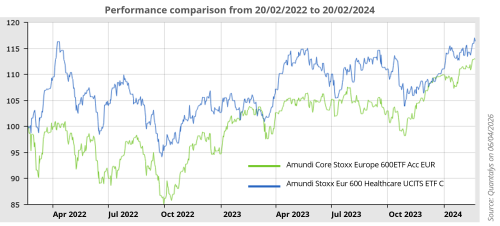
The healthcare sector has historically been seen as a defensive sector, particularly attractive during periods of economic slowdown, market volatility or geopolitical uncertainty.
The reason is simple: healthcare spending is non-discretionary. Patients continue to require care, treatment and medicines regardless of the economic backdrop.
Demand is therefore relatively stable, as it is driven by essential needs and is often partly covered by insurance systems or public healthcare programmes. This gives the sector more recurring, more predictable revenues that are generally less sensitive to economic growth than those of more cyclical sectors.
In the current environment, certain large-cap healthcare names with strong franchises, well-developed drug pipelines, good revenue visibility and robust balance sheets appear to offer attractive ways to navigate the current backdrop while also providing longer-term investment potential.
Pharmaceutical companies
Within healthcare, the pharmaceutical segment appears particularly well positioned.
By nature, the pharmaceutical industry is resilient during economic slowdowns, as the need to treat disease does not disappear when growth weakens.
Demand remains especially well supported for essential medicines, particularly in areas such as:
- oncology,
- cardiovascular disease,
- immunology,
- chronic conditions.
These treatments are considered essential for patients, which materially limits the sensitivity of demand to the economic cycle. In other words, unlike cyclical sectors, pharmaceutical companies remain relatively protected from weaker consumer spending or a deterioration in the broader macroeconomic environment.
Key watchpoint : while the pharmaceutical sector is defensive by nature, it remains exposed to significant stock-specific risk linked to clinical trials. Phase III trial results are particularly closely watched by investors, as they represent a key step ahead of potential commercialisation. When such trials involve a potential blockbuster product (capable of generating more than US$1bn of annual sales), they can lead to significant share price moves, both up and down, depending on whether the programme succeeds, is delayed or fails.
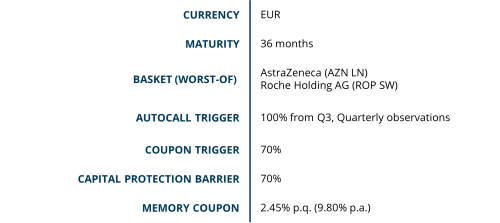
- AstraZeneca (AZN LN)
- Roche Holding AG (ROP SW)
More information available in the Full Trade Idea
Product Snapshot | Phoenix Worst-of
For informational purposes only. Not investment advice.
The healthcare sector
The healthcare sector has historically been seen as a defensive sector, particularly attractive during periods of economic slowdown, market volatility or geopolitical uncertainty.
The reason is simple: healthcare spending is non-discretionary. Patients continue to require care, treatment and medicines regardless of the economic backdrop.
Demand is therefore relatively stable, as it is driven by essential needs and is often partly covered by insurance systems or public healthcare programmes. This gives the sector more recurring, more predictable revenues that are generally less sensitive to economic growth than those of more cyclical sectors.
In the current environment, certain large-cap healthcare names with strong franchises, well-developed drug pipelines, good revenue visibility and robust balance sheets appear to offer attractive ways to navigate the current backdrop while also providing longer-term investment potential.
Pharmaceutical companies
Within healthcare, the pharmaceutical segment appears particularly well positioned.
By nature, the pharmaceutical industry is resilient during economic slowdowns, as the need to treat disease does not disappear when growth weakens.
Demand remains especially well supported for essential medicines, particularly in areas such as:
- oncology,
- cardiovascular disease,
- immunology,
- chronic conditions.
These treatments are considered essential for patients, which materially limits the sensitivity of demand to the economic cycle. In other words, unlike cyclical sectors, pharmaceutical companies remain relatively protected from weaker consumer spending or a deterioration in the broader macroeconomic environment.
Key watchpoint : while the pharmaceutical sector is defensive by nature, it remains exposed to significant stock-specific risk linked to clinical trials. Phase III trial results are particularly closely watched by investors, as they represent a key step ahead of potential commercialisation. When such trials involve a potential blockbuster product (capable of generating more than US$1bn of annual sales), they can lead to significant share price moves, both up and down, depending on whether the programme succeeds, is delayed or fails.
- AstraZeneca (AZN LN)
- Roche Holding AG (ROP SW)
More information available in the Full Trade Idea
Product Snapshot | Phoenix Worst-of
For informational purposes only. Not investment advice.